
TRIT THRESHOLD: Mars Evacuation
A hardcore, education-focused ternary circuit design game
Win a ternary war with real circuits
You are Shen Heng, a Mars maintenance engineer. When the ARES-7 evacuation crisis breaks out, you wake LUMEN-3 and fight GATE’s binary evacuation protocol with real circuits and ternary logic — building every gate from voltage up, by hand.
T = −5V · 0 = 0V · 1 = +5V
features
Features
Fully balanced ternary
T maps to -5V, 0 to ground, 1 to +5V. A floating node is not 0 — it is high-impedance; shorted supplies fall into an illegal state. This rule set is the semantic foundation of every circuit, timing and verification system in the game.
Two simulators
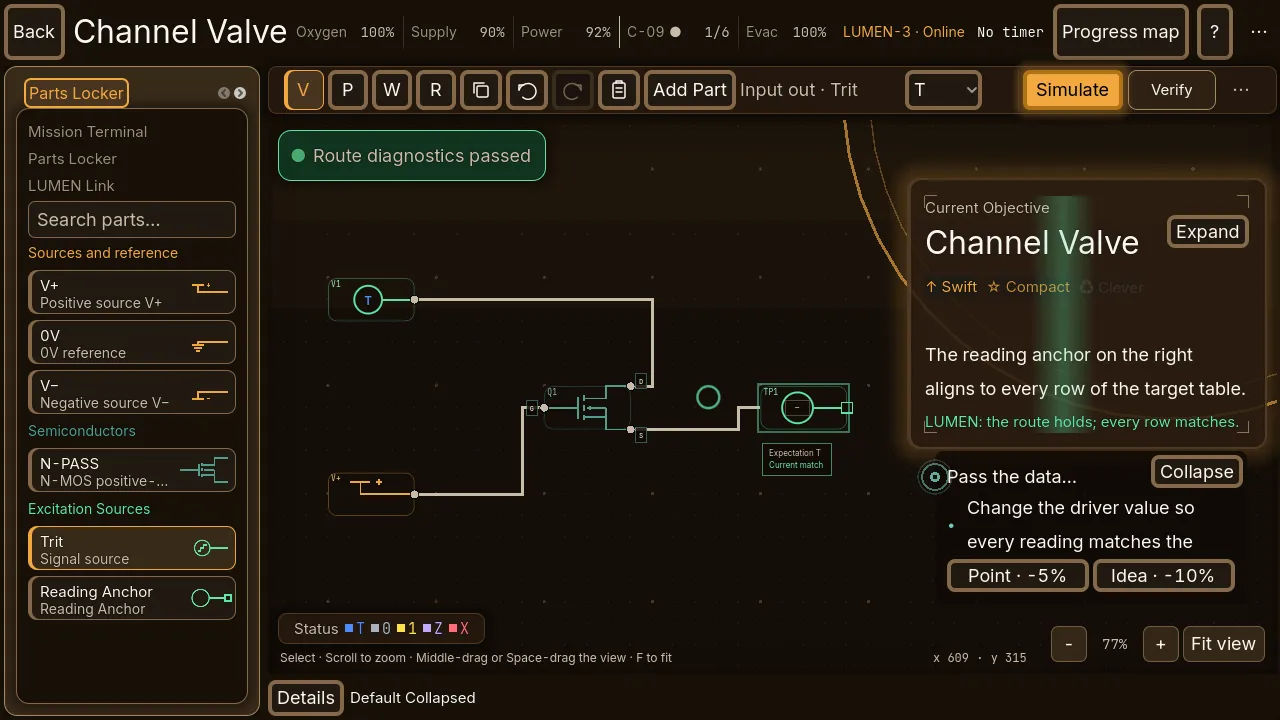
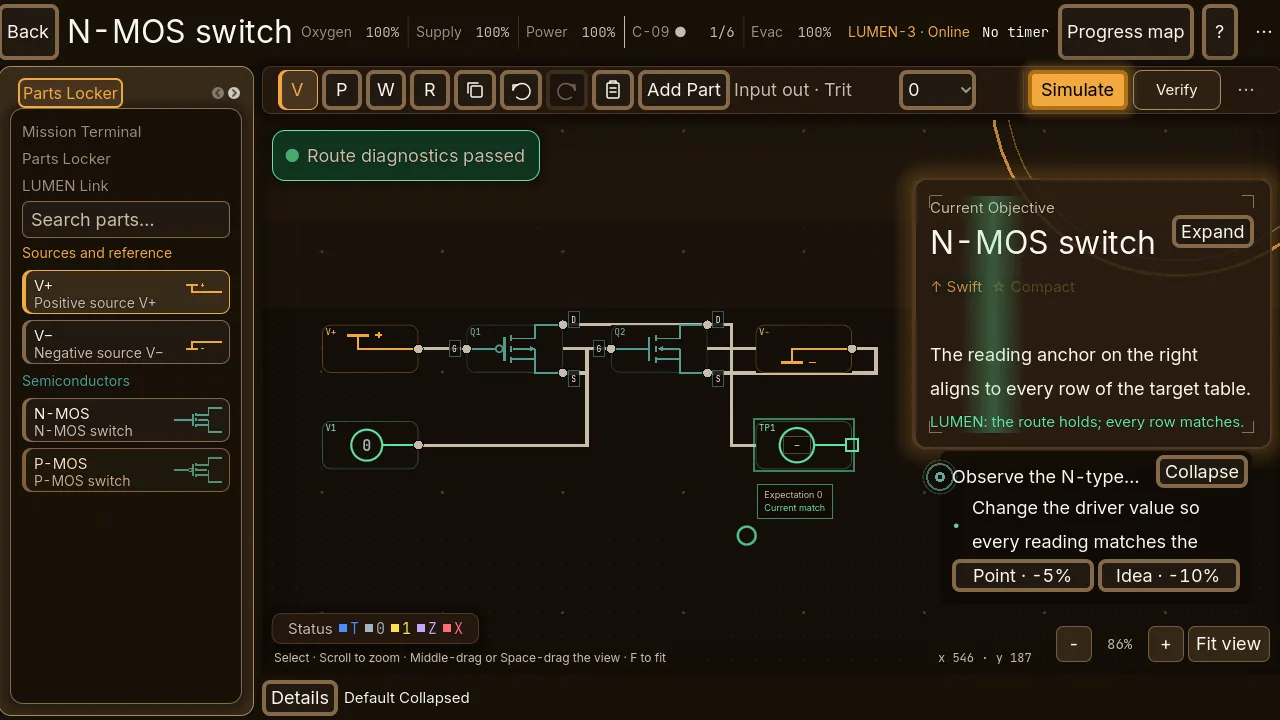
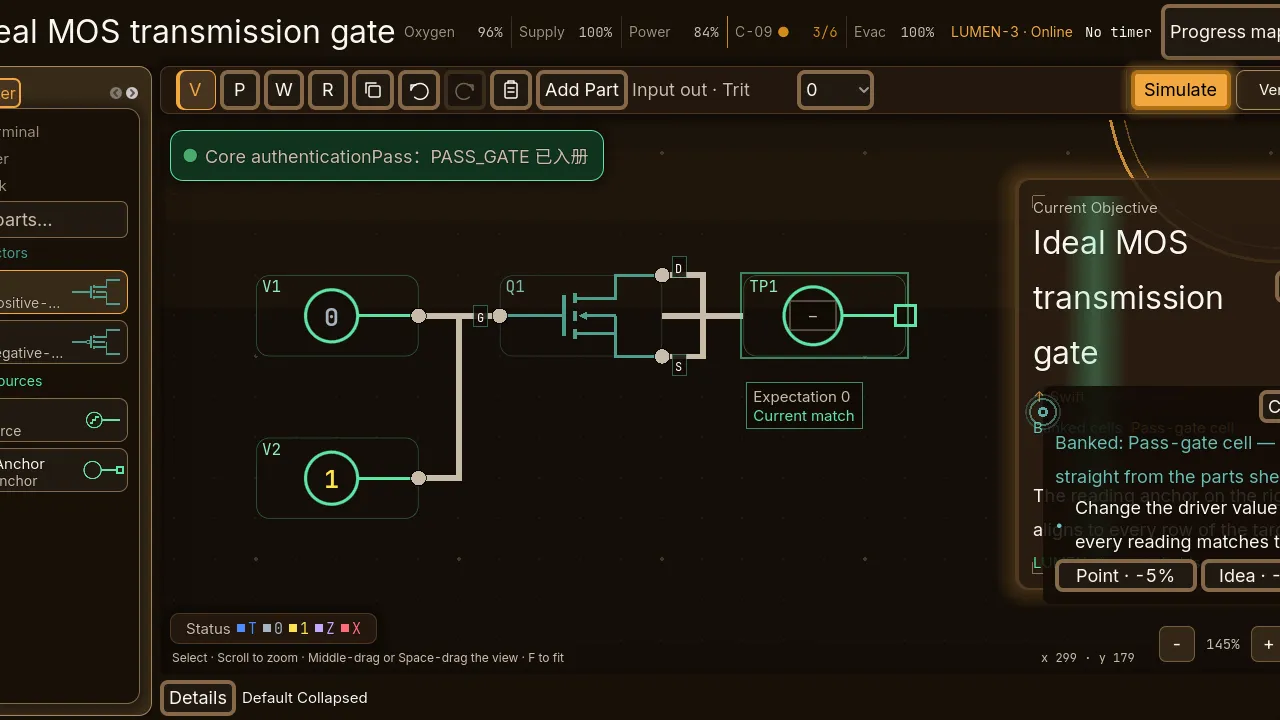
The voltage layer is a real nonlinear circuit simulator — Ohm’s law, Kirchhoff, the 0.7V BJT drop, MOSFET thresholds. Characterization exhaustively packages your circuit into a cell — and it can fail. The logic layer is a digital simulator where you build gates, adders and processors out of T/0/1/Z/X.
The Mars campaign
Beyond circuits, the campaign tracks the mission clock, oxygen, supplies, power, the C-09 signal count and the evacuation window. Eight endings emerge from branches, diagnostic completeness and resource limits.
Hardcore, for learning
“Zero is a voltage phenomenon, not a logic one” — the step that happens in real design but almost never in teaching is something you perform with your own hands here.
story
Story
You are Shen Heng, a Mars maintenance engineer. The ARES-7 evacuation crisis breaks out, and the base protocol GATE rules: execute the highest-priority evacuation, by binary logic.
But you wake LUMEN-3 — an old engineering machine that thinks in ternary. To GATE there are only 0 and 1, leave or stay; what you must prove is that real circuits hold a third answer.
Every gate, every adder, you build from voltage up, by hand. Fix it, and bring the right people home.
// GATE evacuation protocol · broadcast #7
GATE: Executing the binary protocol. Take, or leave.
// LUMEN-3 · cold start
LUMEN-3: …a third state detected.
// your move
▮
gameplay
Three-stage gameplay
Connect supplies · discharge · switch transistors
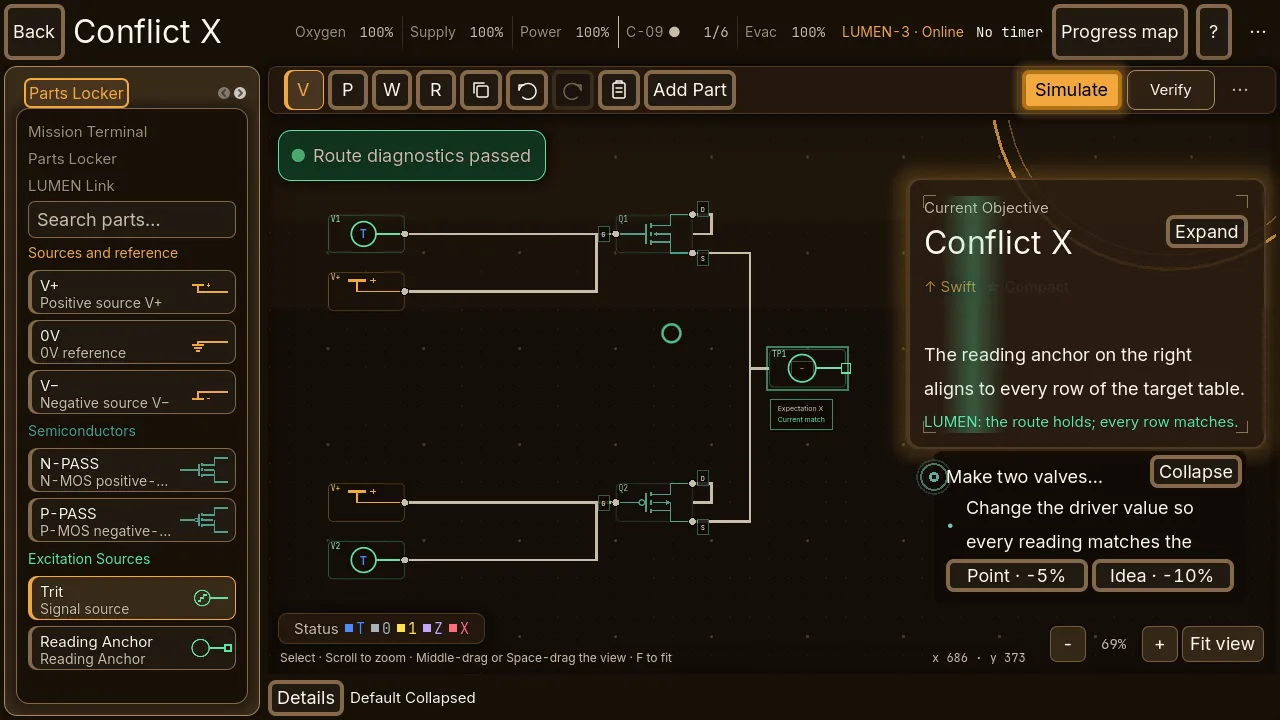
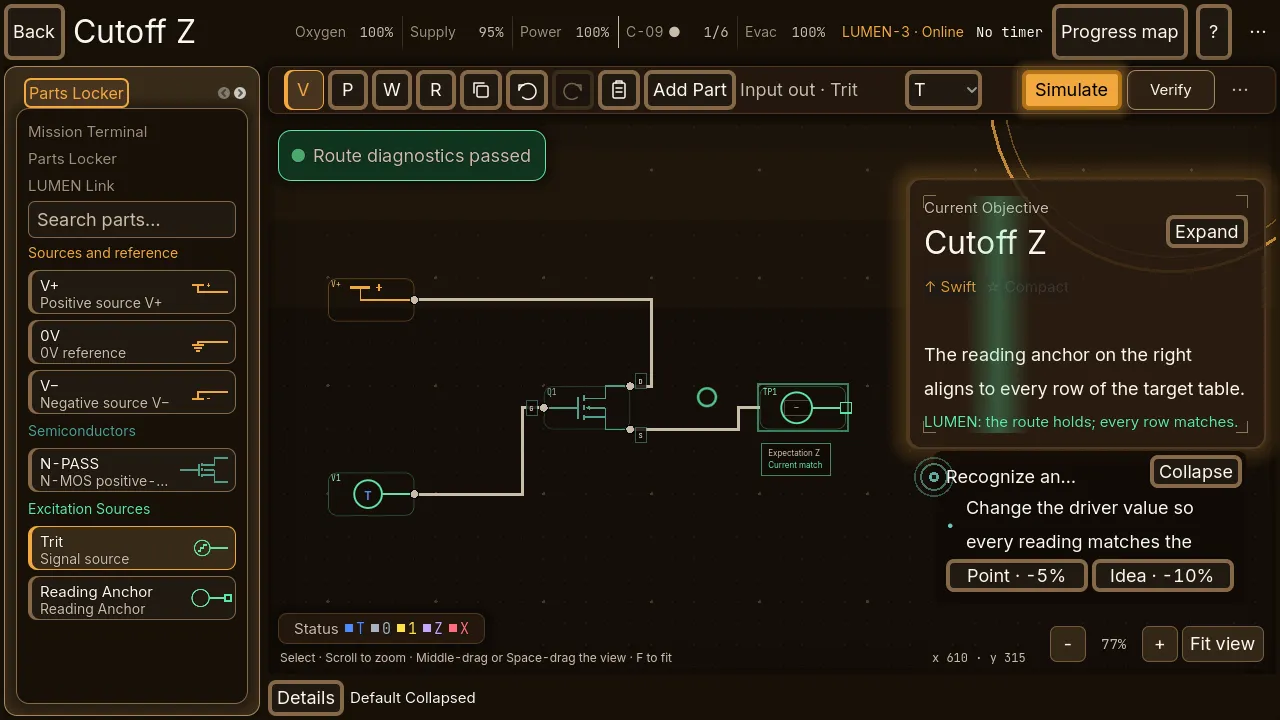
A real nonlinear circuit solver — Ohm’s law, Kirchhoff, the 0.7V BJT drop and current gain, MOSFET thresholds. You build an equal-resistance divider with your own hands and watch zero as a voltage phenomenon.
Package tuned circuits into cells
Exhaust the input combinations, solve the DC operating points, judge the output voltages — a true cell characterization. It can fail: if an output lands between decision windows, that circuit cannot serve as a digital device.
Compose gates · adders · processors
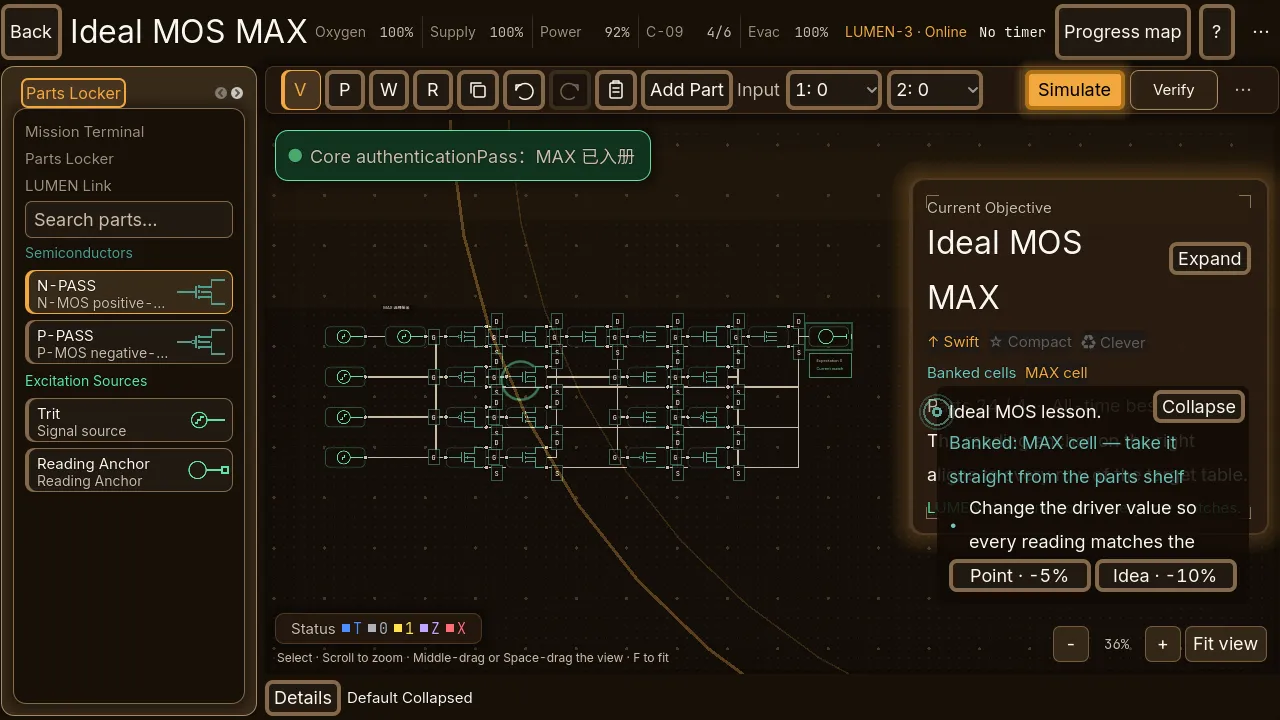
Beyond the digital boundary there is no voltage, only judged T / 0 / 1 / Z / X. The divider phenomenon never appears here — exhaustive verification proved it would break digital convergence guarantees.
interactive
Flip a ternary gate yourself
Click the inputs to cycle T / 0 / 1 and watch the NOT and MIN/MAX outputs move — a first lesson in "logic is judged voltage".
NOT · invert
MIN · ternary AND
MAX · ternary OR
Truth table (rows A · cols B)
| Logic | Value | Circuit |
|---|---|---|
| T | −1 | −5V |
| 0 | 0 | 0V (GND) |
| 1 | +1 | +5V |
| Z | — | high-Z (floating) |
| X | — | illegal (conflict) |
gallery
Screenshots


roadmap